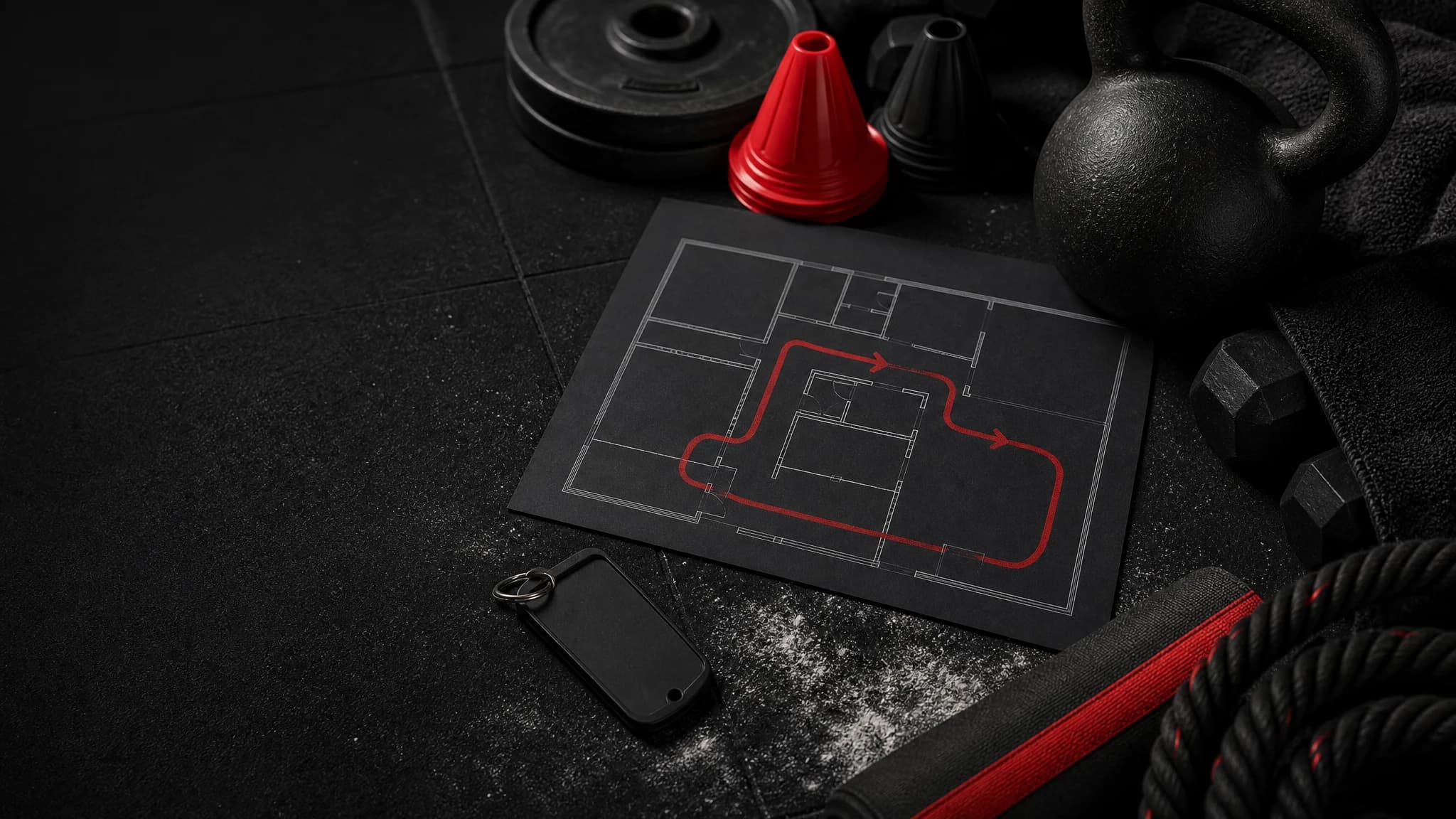
When a trainer is choosing a gym for their own clients, the starting point should not be which place has the most equipment or the nicest photo on the website. What matters more is whether your service can be delivered there professionally and over the long term: without chaos at reception, without unclear rules, without constantly waiting for equipment, and without the client having to overcome unnecessary obstacles before the session has even begun.
Contents
First, get clear on the type of client and service
Start with who you train and what service you want to sell. A beginner returning after a long break needs a different environment from a performance-focused client working on strength, weightlifting or conditioning. A corporate client may care most about accessibility and an easy entry process. A client with low confidence will appreciate quieter zones and clear guidance from reception through to the session.
This helps you avoid a common mistake: choosing a gym based on your own preferences as a trainer rather than the client experience. You may be able to improvise between stations, but a paying client expects the session to be smooth, safe and easy to manage.
- For beginners, look at how easy the space is to navigate, whether there is enough calm to explain technique, and whether basic equipment is readily available.
- For strength clients, think about racks, platforms, plates, whether dropping weights is allowed, and how busy it gets at peak times.
- For clients under time pressure, accessibility, parking or public transport, changing rooms and quick entry are essential.
- For seminars, small groups or assessments, ask about a separate studio, classroom, massage room or InBody.
Sort out the collaboration rules before the first session
For an external trainer, the rules of collaboration matter just as much as the equipment. In the Czech market, it is not a given that you can bring a paying client into any fitness centre. Some venues explicitly forbid it without a written agreement, and breaking the rules can create problems for both you and the client.
A written arrangement protects everyone involved. You know what you are paying for and what you are allowed to use. The operator knows who is running a business in the space. The client does not end up in a situation where reception is trying to work out whether you are even allowed to train there.
- Are you allowed to train your own clients in the space, or only the gym’s clients?
- Do you pay a fixed monthly fee, a percentage of training income, client entry fees, or a combination?
- Who deals with the client’s entry, booking, cancellation, late arrival and first orientation in the space?
- What are the rules for using studios, small equipment, filming, photography and commercial content?
- What is set out in writing: liability, insurance, damage, injury, termination of the collaboration and changes to the terms?
You may also want
Assess equipment by usability, not first impressions
Do not judge equipment by how much there is, but by whether it fits your programme and can be used in real day-to-day operation. One quality rack available at the right time can be more valuable for your work than ten machines you do not need.
Walk through a typical session step by step. Where will you do the warm-up? Where will you teach a basic pull or squat? Do you have space to correct technique? Where will the client put their things? What will you do if the main rack, cable machine or functional training area is occupied?
When training a client, it also matters how easy the space is to read. If you have to move through a busy gym between every exercise, wait for equipment, or repeatedly explain why the plan is changing, the client does not just notice that the gym is objectively busy. They notice that the session lacks flow.
You may also want

Want to work on this in practice?
Trainers offer
Accessibility in Prague shapes client retention
In Prague, choosing a gym often comes down to logistics. A client may manage to travel across the city once, but long-term collaboration depends on repeatability. If the journey takes too long, the changing rooms slow things down, parking is unreliable or entry is complicated, the client will cancel more often and be less willing to add another session.
So do not check the location only at a time that suits you. Visit at the times you actually train: in the morning before work, after work or around lunchtime. Pay attention to how busy it is, the atmosphere, access to key stations, and how quickly a new client can find their way from the door to the training floor.
You may also want
Safety, maintenance and cleanliness affect trust
Safety and maintenance are not just dull operational details. International professional frameworks for personal trainers routinely address emergency procedures, safe equipment layout, cleanliness, servicing plans and how easily clients can orient themselves in the space. For a trainer, this means one simple thing: the space should reduce risk, not shift it onto your ability to improvise.
During a viewing, pay attention to surfaces, clear walkways, the condition of racks, benches, cable machines, bands, kettlebells, bars, plates and smaller accessories. Check where damaged equipment is reported, who handles first aid, and what happens in the event of an injury. For clients with health limitations, after an injury, or with unclear symptoms, it should go without saying that a trainer works within their competence and recommends a consultation with a doctor or physiotherapist if needed.
Cleanliness has a commercial impact as well. A client who does not feel comfortable in the changing room, shower or on the mat will not, in the long term, judge only the operator. They will judge the whole service you are recommending to them.
You may also want
The economics of collaboration need to make sense six months from now too
When choosing a gym, calculate not only the monthly fee but also how much energy client servicing costs you. If you pay less but spend time explaining entry arrangements, moving sessions, looking for free space and dealing with operational conflicts, the cheaper option may turn out to be expensive.
At ARENA GYM, the offer for external trainers is built around clear membership terms and no commission on your own clients. What matters for a trainer is that you set your own price for your work and can choose facilities based on the type of service: the city centre for clients from Prague 1, Jinonice for work in Prague 5, or a combination of both branches. Depending on whether you work one-to-one, in pairs, with a group, or educate clients, InBody, a massage room, a teaching room, studios or the option of hourly hire may also make sense.
That does not mean one gym is universally the best for every trainer. It means a good choice should be economically clear, operationally predictable and aligned with how you want to work over the coming months, not just next week.
You may also want
Running your own client base: pre-contract checklist
Confirm client entry, space booking, cancellations, peak times, equipment storage, liability and incident procedures. Clarify who communicates and invoices and how personal and health information is protected.
Test the client journey from the entrance to the training area. Price is only one part; unclear rules and overcrowding can cost more.
Common questions
What should I base my choice of gym for my own clients on?
First, get clear on who your clients are, when you most often train them, and what type of space you actually need for that. Only then should you look at equipment, price and location. A gym that is excellent for advanced strength training may not be ideal for beginners, corporate clients or clients coming back after a longer break.
Is the gym environment really part of my brand?
Yes. The space is part of the service for the client, even if you are not the one selling it directly. If reception is disorganised, the rules are unclear, the changing rooms are poor, or every visit is logistically difficult, the client will connect that with the whole training experience. A good gym, on the other hand, helps you come across as more professional without you having to explain and rescue every detail.
Can I bring my own client into any gym?
Definitely not without an agreement with the operator. Many fitness centres prohibit external trainers from working there without a contract or prior consent. Before the first session, check what the collaboration model is, who pays the client’s entry fee, how bookings work, whether you can use studios, and whether there are rules for commercial photography or filming.
What should I ask the operator before agreeing anything?
Ask about the collaboration model, monthly costs, any commission, the rules for client entry, equipment availability at peak times, the option to reserve space, how injuries are handled, liability for damage, internal communication with reception, and what happens if a client arrives on their own for the first time. These details are exactly what determine whether the space will work well for you in the long term.
When is a gym not worth choosing, even if it looks good?
When it is cheap or looks good, but does not match your type of clients. Warning signs include unclear rules, overcrowded peak hours, poor hygiene, badly maintained equipment, an unfriendly approach to external trainers, complicated client entry, or an environment where you have to improvise for most of the session.
Want to work on this in practice?
Choose a space that makes life easier for both you and your client
A good gym for your own clients is not the one with the longest list of machines. It is a space where your service can be delivered repeatedly without unnecessary improvisation: the client can get there, knows what to do, has decent facilities, and you have clear rules for your work.
Before you decide, walk through the gym as both a trainer and a client. Follow the journey from arrival through the changing room to the specific training area, ask about the collaboration model, and check what a normal session will look like at the times you actually work. If the space supports your service, it will help you grow. If it complicates it, you will pay for its weaknesses with your own time, energy and your clients’ trust.
Author: ARENA GYM Updated: 18 August 2026