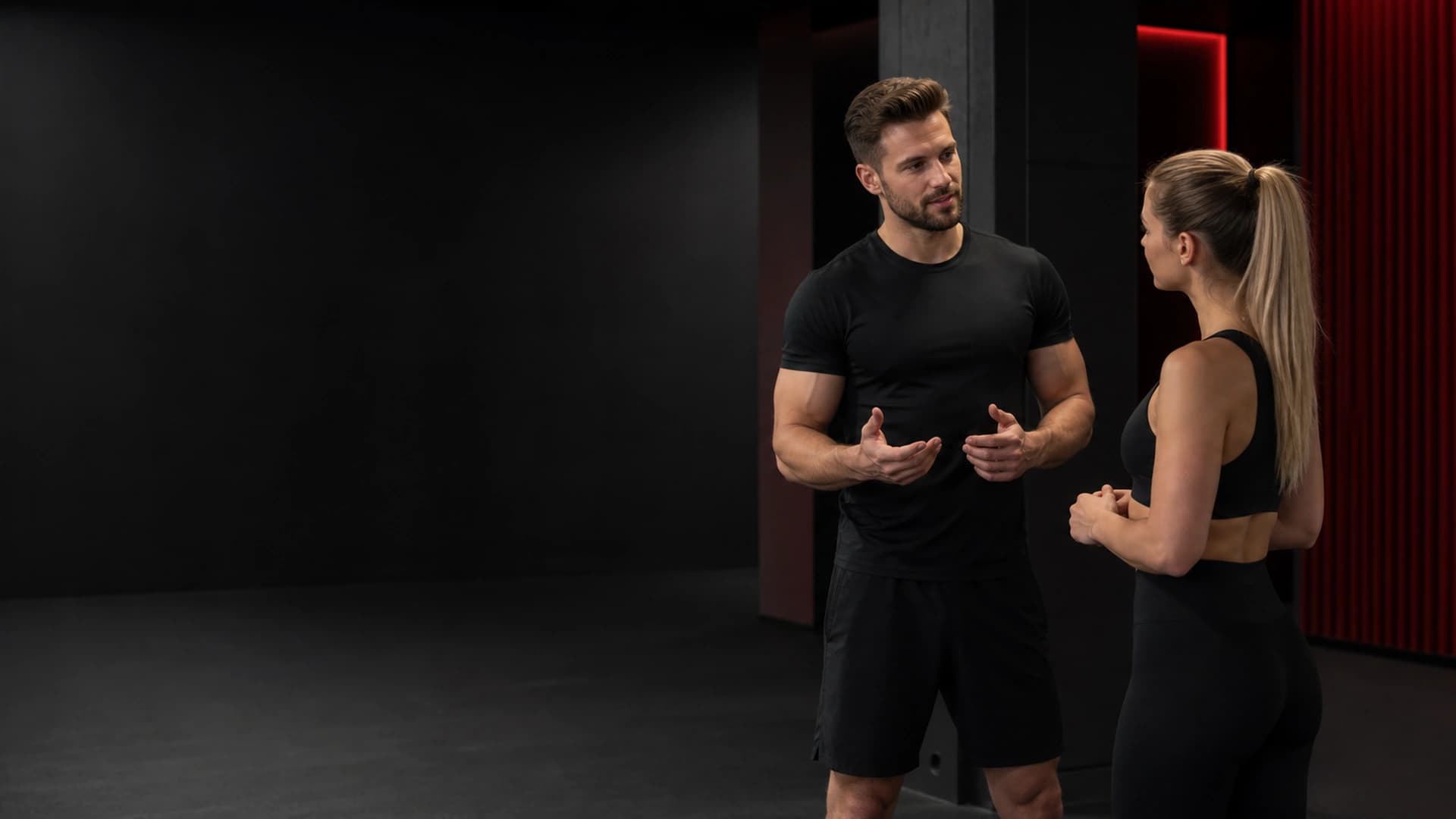
A first consultation with a trainer shouldn’t just be a quick “so what do you want to work on?”. It’s the moment to put the context together: why you want to start, what you’ve already done, what limits you, how much time you realistically have, and whether personal training is even the best form of coaching for you.
Contents
The first meeting should gather context, not just impressions
A good start doesn’t look like a trainer promising the ideal plan within five minutes. First they need to find out who is sitting in front of them. Otherwise, the plan will be based more on impression than reality.
There should be questions about your main goal, previous training experience, current fitness, pain, injuries, operations, medication or diagnoses that may affect movement. Your typical week matters just as much: desk work, sleep, stress, shifts, travel, family, and the time you genuinely want to give to training.
That isn’t unnecessary curiosity. Without this information, it’s not possible to sensibly decide whether to start with strength training, basic exercise technique, mobility, fitness, a change in frequency, or a consultation with a physiotherapist or doctor first.
What to bring to the consultation
You don’t need to arrive with a perfectly phrased goal. It’s enough to honestly prepare the basic information. That way, the trainer doesn’t have to guess whether your main aim is weight loss, getting stronger, feeling less intimidated by the gym, returning after a break, managing back pain at work, or learning to train independently.
If you have medical reports or recommendations from a physiotherapist, bring them with you. The trainer shouldn’t be making a diagnosis from them, but they can help them understand the limits of the coaching and avoid unnecessary risk.
- Your main goal and why you want to address it right now.
- Previous experience with the gym, group classes, sport or rehabilitation.
- Pain, injuries, operations, health limitations, and situations where movement gets worse.
- How much time you can realistically manage each week, not what would be ideal.
- What you expect from the trainer: technique checks, a plan, motivation, independence, or long-term guidance.
You may also want
What a trainer may check as a first step
The consultation may include a simple movement check: how you squat, how your hip, ankle or shoulder moves, how you handle basic pushing, pulling, support or stability. It doesn’t have to be a hard performance test. Often it’s enough to see how your body behaves in simple situations.
The point isn’t to embarrass anyone, but to choose a safe starting point. For a beginner, range of movement and technique may matter more than the number of reps. For someone more experienced, the consultation may show why progress has stalled, where the weak point in the programme is, or why their current frequency doesn’t suit them.
If you have pain, tingling, a major restriction in range of movement, dizziness, chest pressure, or you’re recovering from an operation, a good trainer won’t try to play the hero. They should clearly say when a professional assessment or work with a physiotherapist is the better first step.

Want to work on this in practice?
Trainers
What should be clearer after the meeting
After a good consultation, you shouldn’t leave with just the package price. You should know what the first step will be, why that step makes sense, how often to meet, and what the trainer will need from you between sessions.
For some people, regular personal training twice a week makes sense. For others, it’s enough to fine-tune technique once a week or once a fortnight and do the rest independently in the open gym. Someone else may find that a group class or a combination of formats suits them better.
- What the nearest sensible goal is for the first 4 to 8 weeks.
- How many times a week it makes sense to train with a trainer, and what to do outside the sessions.
- What the first training session will look like and how load will be progressed.
- Which exercises or level of intensity are better avoided for now.
- How progress will be judged: technique, strength, fitness, consistency, pain, energy or measurements.
How to spot a good sign and a bad one
A quality consultation should be specific, but not manipulative. A trainer may recommend an approach, frequency and coaching format, but they should be able to explain why. If they push for a quick decision without asking about your health, time availability and experience, that’s a weak sign.
Also be careful with one-size-fits-all solutions. The same plan for someone who hasn’t moved properly in years, an athlete returning from injury, and someone who just wants to improve their squat technique doesn’t make sense.
A good trainer can also say “this is outside my competence”. Nutrition, pain, diagnoses, rehabilitation or mental health issues all have their boundaries. A trainer can help with movement and habits, but they shouldn’t replace a doctor, physiotherapist or nutrition professional where specialist care is needed.
You may also want
How this fits into choosing training at ARENA GYM
At ARENA GYM, a first consultation can help you decide whether to start with personal training, the open gym, a group class, or a combination. That’s especially practical in Prague, where people often have to think not just about the trainer, but also branch location, time after work, public transport links and whether they’ll realistically be able to come regularly.
If you already know you want long-term individual coaching, discuss a specific coaching plan with the trainer. If you’re not sure, treat the consultation as a way to make a clearer decision. The point isn’t to sell personal training at any cost, but to find a format you’ll actually be able to stick to and that matches your goal.
Common questions
What should be covered in the first consultation?
It should cover your goal, health and movement history, current routine, time availability, previous experience, any limitations, and what you expect from the coaching. A good trainer won’t just ask how much weight you want to lose or how often you want to come.
Does the consultation have to include testing?
Not necessarily. For most people, a conversation, a simple movement check and an agreement on the next steps are enough. If you have pain, a post-injury condition or a health limitation, the trainer may recommend seeing a doctor or physiotherapist first.
Is the meeting worthwhile even if we don’t start training straight away?
Yes. If afterwards you understand how the trainer thinks, what a sensible route would be, what frequency makes sense, and whether you click both personally and in terms of process, the consultation had value even without an immediate purchase.
What should I prepare before the consultation?
Bring information about your goal, previous exercise, injuries, operations, pain, medication or diagnoses that may affect movement. It also helps to have a rough idea of your weekly routine, available time and budget.
How can I tell if the consultation wasn’t good?
Warning signs include pressure to quickly buy a package without any questions about your context, promises of guaranteed results, dismissing pain, a one-size-fits-all plan, or an unwillingness to say when another professional would be a better fit.
Want to work on this in practice?
A consultation should help both sides make a better decision
A first consultation is not a formality or a sales obstacle before training. It’s a filter that protects the time, money and health of both sides.
A good outcome is not necessarily a finished six-month plan. A good outcome is a clearer goal, a sensible first step, honestly named limits, and the feeling that the trainer understands your context.
Sources
Author: ARENA GYM Updated: 18 August 2026